Total Pageviews

Showing posts with label behavioral economics. Show all posts

Tuesday, 15 October 2019

Poor Economics and the Nobel Prize
It’s great news that the husband and wife team of Abhijit Bannerjee and Esther Duflo (along with Michael Kremer) have just been awarded the Economics Nobel Prize. Not just because it’s only the second time that a woman has won, or because Esther Duflo is young compared with the 60+ norm for Nobel Prize winners. But because the work of all three focuses on poverty, and uses an experimental rather than a theoretical approach – what works, rather than what presents as a neat and elegant solution. 
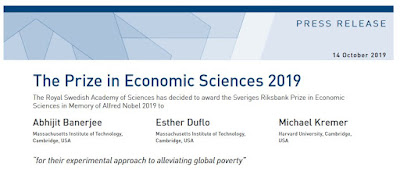
And following Daniel Kahneman in 2002 and Richard Thaler in 2017, this is the third time that a behavioural approach has featured in the economics Nobel prize.

The work of Bannerjee and Duflo featured in their book ‘Poor Economics,’ where they set out their focus: the lives and choices of poor people. As the authors state, the debates on poverty are usually framed by looking at the big questions – what is the ultimate cause of poverty? How much faith should we place in free markets? Is democracy good for the poor? Does foreign aid have a role to play?  Whereas as Bannerjee and Duflo note in the book, "the studies we use have in common a high level of scientific rigour, openness to accepting the verdict of the data, and a focus on specific, concrete questions of relevance to the lives of the poor."

They invite us to turn away from the feeling that the fight against poverty is too overwhelming and to start thinking of the challenge as a set of concrete problems that, once properly identified and understood, can be solved, one at a time. There’s a lot of behavioural economics in their approach, not because the psychology of poor people is different, but because it’s the same: poor people can be trapped by the same kinds of problems that afflict the rest of us, like lack of information, weak beliefs, and procrastination.

What We Take For Granted

Our real advantage comes from the many things that we take as given: we live in houses where clean water gets piped to us - we do not need to remember to add chlorine to the water supply every morning. The sewage goes away on its own - we do not actually know how. We can mostly trust our doctors to do the best they can - and can trust the public health system to figure out what we should and should not do. We get our children immunized (mostly!). Our health insurers reward us for joining the gym - because they are concerned that we will not do it otherwise. And perhaps most important, most of us do not have to worry where and our next meal will come from. In other words, we rarely need to draw upon our limited endowment of self-control and decisiveness, while the poor are constantly being required to do so.

Make It Easy

The authors invoke the spirit of Nudge to ensure that policies and practices are designed to make it as easy as possible for poor people to make the choices that are best for them. But a lot of the cheap gains are in prevention, and prevention has traditionally been the area where the government is the main player. The trouble is that governments have a way of making easy things much less easy than they should be – eg, government health centres are often closed when they are supposed to be open.

If people in the west, with all the insights of the best scientists in the world at their disposal, find it hard to make basic choices on hard evidence, how hard it must be for the poor, who have much less access to information?  And even the most well intended and well thought out policies may not have an impact if they are not implemented properly. Unfortunately, the gap between intention and implementation can be quite wide

B&D remind us that we need to resist the kind of lazy, formulaic thinking that reduces every problem to the same set of general principles. We should listen to poor people themselves and understand the logic of their choices. We must accept the possibility of error and subject every idea, including the most apparently common-sensical ones, to rigorous empirical testing. Doing all of this means we will be able not only to construct a toolbox of effective policies but also to better understand why the poor live the way they do.

In summary: attend to the details, understand how people decide, and be willing to experiment. All economists should take note!

Friday, 13 October 2017

Behavioural economics goes mainstream with Richard Thaler’s Nobel Prize

The Nobel prize for Economics (technically, the Sveriges Riksbank Prize in Economic Sciences in Memory of Alfred Nobel) has previously been awarded to academics working in the field of decision-making, psychology and economics (Herbert Simon in 1978 and Daniel Kahneman in 2002). But the announcement last week that the 2017 prize would go to Richard Thaler, was the first which explicitly mentioned the award being for contributions to behavioural economics."


The citation defines behavioural economics as “a research field in which insights from psychological research are applied to economic decision-making. A behavioural perspective incorporates more realistic analysis of how people think and behave when making economic decisions, providing new opportunities for designing measures and institutions that increase societal benefit.”

Thaler’s research was praised for incorporating psychological assumptions into analyses of economic decision-making, his work showing how the limitations of an individual’s knowledge in the decision-making process, as well as the consequences of social preferences and a lack of self-control, can affect people’s decisions as well as market outcomes.  The Royal Swedish Academy of Sciences described Thaler as a pioneer of behavioural economics, saying that it had progressed in recent years from a fringe and somewhat controversial field of research into “a mainstream component of the economics profession.

Behavioural economics and me

Ten years ago media images showed queues of anxious depositors in British high streets as the crisis at Northern Rock, the first run on a British bank for around a century, became the clearest sign that all was not well in the financial system. A year later, the collapse of Lehman Brothers signalled the full blown emergence of the Global Financial Crisis. These momentous financial events coincided with my new job as an economics lecturer at Brighton Business School, University of Brighton. Economics 101, which I was teaching to first year undergraduates, was hard-pressed to explain the most momentous economic events in living memory. Which was why I turned to other schools of thought, including behavioural economics, launching what turned out to be a series of popular modules on the subject.

Rethinking economics and behavioural economics

Fast forward a few years, and I was invited by the folks at Rethinking Economics to contribute a chapter on Behavioural Economics to a forthcoming reader, aimed at providing an accessible introduction to different approaches to economics and highlight the diversity of economic thought.  The book, which has just been published, introduces new and diverse ideas into undergraduate economics and places the mainstream of economic thought side by side with more heterodox schools. 


According to the publishers, Rethinking Economics: An Introduction to Pluralist Economics is “a great entry-level economics textbook for lecturers looking to introduce students to a broader range of economic ideas, and is  accessible for people outside academia who are interested in economics and economic theory. Can’t say fairer than that.

The Table of Contents from the Reader is a roll-call of alternative economics:

·       Post-Keynesian Economics
·       Marxist Economics
·       Austrian Economics
·       Institutional Economics,
·       Feminist Economics
·       Complexity Economics
·       Co-operative Economics
·       Ecological Economics
·       And my chapter on Behavioural Economics

According to Richard Thaler’s Nobel Prize citation, behavioural economics has become “a mainstream component of the economics profession.” It’s going to be interesting to see if the rest of the “economics profession” agrees!

Thursday, 26 November 2015

Rethinking Economics meets Behavioural Economics meets Behaviour Workshops


Rethinking Economics is an international network of rethinkers working together to “demystify, diversify and invigorate economics.” It was great to be asked to write a chapter on Behavioural Economics for their forthcoming reader, “An Introduction to pluralist economics,” to be published this year by Routledge. It’s equally delightful that the draft has now been set to the editor! Each chapter of the book will contain a brief introduction to a different field of economic thinking, written by an academic in the subject, plus a case study co-written by a student. More details here.

Wednesday, 30 September 2015

Nudging in the Smoke, Part 2: London Behavioural Insights Conference BX2015

The Behavioural Insights Team has now posted the videos from the plenary sessions, individual streams and workshops from the London Behavioural Insights Conference BX2015. So, no excuse for not catching up with all the latest material from behavioural economics and behavioural insights as applied to behaviour change interventions and policy. Click here.  

If you don’t have time to watch all the videos, following, as a public service (we were there, in real time), is our pick of the quotes from the sessions which we attended.

Reasons to be humble

“When we observe behaviour that we don’t understand, it can be because people actually know things that we don’t.”

Rachel Glennerster

“The poor are largely unseen.”

Eldar Shafir

Women Are Missing…and here’s what to do about it

“Between 100 million and 160 million girls and women are ‘missing’ because of sex-selective abortion, mistreatment and abuse.”

“Seeing is believing. If we don’t see women as CEOs or men as kindergarten teachers, we don’t believe it’s possible.”

“When it comes to tackling gender inequality, rather than change people’s minds, we should change the environment in which people live and work.”

“We have known for over 60 years that a selection interview is a poor predictor of future performance. And panel interviews are even worse because of groupthink.”

“Don’t establish a prescriptive norm by how you describe things, such as the lack of women in certain fields.”

Iris Bohnet

The Curse of Knowledge strikes again

“Writing is an act of pretence and craftsmanship.”

“The curse of knowledge is the biggest barrier to clear writing.”

Steven Pinker

How reciprocity can beat the market

“There are six universal principles of social influence: reciprocation, liking, scarcity, social proof, authority, commitment.”

“If a change is small, it’s more likely to be implemented by the people who you are asking to do it.” (although it could bring major results)

“Reciprocity is about more than the traditional economic tit-for-tat model based on exchange. And it’s better if you go first, because people will want to give in return.”

“You should always think about what you can give that helps meet the needs of your audience.”

“Ernest Hemingway’s bet-winning short story, told in six words: ‘For Sale: baby shoes. Never used.’ “

“Start with a broad smile.”

Robert Cialdini

Multi-tasker? Yeah, Right.

“Multi-tasking is a myth. We can’t do more than one thing at a time.”

Marjorie Stiegler

Insights and Advice from Daniel Kahneman

Advice to those trying to influence policy makers: “What is preventing people doing the things that you want them to do? When you implement the policy who will be the losers and what will they do to you?

Advice to students: “Be less about (the) literature and more about life.”

Advice to everyone:  “Don’t study anything that isn’t interesting or fun. Don’t worry so much. And know when to give up.”

Answering a question from Steven Pinker on whether de-biasing should be part of the curriculum:

“It should be possible to give people the chance to slow down and reflect on what they are doing. But people can’t be reflective all the time. For decision making, structure is a good thing. But this isn’t the same as de-biasing.”

“A lot of decision making in firms and in government is of very poor quality. It has evolved, it has not been designed.”

Daniel Kahneman

The Power of Search and the trouble with economics

“If people are interested in economics, you can be pretty sure that the economy is in trouble.”

From Google search results, “The strongest correlations with “Hardest Place to live in America” are disability, diabetic, blood pressure, antichrist and the rapture.”

Hal Varian

The thin line between honesty and dishonesty

“People normally only take a maximum of four free candies from a malfunctioning (experimentally fixed) vending machine, because five would be stealing.”

“People invite their friends to join in because of reverse social proof – if they do it, it makes it ok that you’ve done it.”

“Corruption is not about knowing that something is wrong – it’s about putting it into a place where you don’t care about it.” (e.g, not in the box marked ‘family’).

“Once you are in a corrupt environment, where the work takes place under different rules, behaviour changes very quickly.”

“The incidence of corruption and cheating is pretty similar across the world. But culture changes the domains in which corruption happens.”

“We think of ourselves in binary terms – we are either good or bad.”

“The logic of confession from the standpoint of an economist: if we can get absolution, why not cheat more. Even on the way to the church.”

“The standard models for understanding corruption are based on cost benefit analysis: the consequences of actions. But it’s actually more to do with rationalisation in the moment.”

“Whistleblowers are more likely to be women, because they aren’t part of ‘the boy’s club’ and aren’t betraying the group.”

“Drunk driving kills people, so we legislate to prevent it. But there are many other ways of killing people that we tolerate. Why?”

Dan Ariely

Markets are looking out for the naïve consumer – it could be you (some of the time)

“Consumers can be naïve or sophisticated, but not all the time. Even sophisticated consumers make mistakes, and markets are good at finding the instance when that mistake is made.”

Paul Heidhues

Firms are not black boxes

“Because firms are run by humans, they may not always profit-maxmimise.”

“Regulatory remedies rely on people acting in certain ways. If these don’t happen, bad outcomes follow.”

“Behavioural economics can be incorporated into the market.”

Amelia Fletcher

Why mindless eating can be a good thing

“It’s easier to change your eating environment than to change your mind.”

“We don’t know what we like, and we don’t know why we do what we do. Both of which are opportunities to change behaviour.”

“In the US, it’s possible to predict a person’s weight based on about nine observable variables in their kitchen. If a cereal box is visible, they are likely to be 20lb heavier than their neighbours.”

Brian Wansink

Last but not least – a few concluding gems

“When it comes to food, the less you pay, the more you get.”

Unidentified contributor

“If you have to go out of your way to think about healthy eating, you won’t do it.”

Sam Kass

“The average British male is eating 200 calories a day more than he needs.”

Alison Tedstone

“It’s important to learn from failure. It’s not just about saying ‘When it works, it’s all down to me and my colleagues. When it doesn’t work, we blame other factors.” You should not be afraid to create a situation in which interventions might fail – you could even give 3 “fails” a year to put in the bank”

Andrea Schneider

“The ancient Greeks were familiar with ‘weakness of the will.’ People do not always do what’s best for themselves.”

Daniel Gordon


Saturday, 5 September 2015

Nudging in The Smoke: Notes, Quotes and Thoughts on the London Behavioural Insights Conference BX2015

For two days this week Behavioural Exchange, the International Behavioural Insights Conference made London the global epicentre of behavioural economics as applied to policy and practice. Or, if you prefer, behavioural science. Or behavioural insight. Or, as Daniel Kahneman memorably (and acerbically put it) when video-linked for a transatlantic interview with Richard Thaler, “applied social psychology.” 


Behaviour Workshops followed the footsteps and soaked up two days of great talks and discussion sessions from some of the greatest names in behavioural economics (and applied social psychology!), with keynote sessions from Thaler and a virtual Kahneman (video linked from New York), as well as Robert Cialdini, Steven Pinker, Dan Ariely, Max Bazerman and Eldar Shafir. Plus a range of parallel sessions featuring experts from fields such as digital behaviours, savings, education, crime, work, obesity, climate change and international development. 

It’s impossible to summarise two such stimulating days - there's a lot of mental processing still going on. In fact, there were so many great quotes that we will be drip-feeding these into the blog over the next few postings.

As a taster, following are a few of the great quotes from Richard Thaler’s conference appearance, starting with his “Two Nudge Mantras”, notably:

1 If you want to nudge people to do something, make it easy.

2 We can’t do evidence-based policy without evidence.”

Another, memorable quote, which he always puts in his book signings,

“Nudge for good.”

And here are a few more,

“It’s good to have policy where, 'if you do nothing, good things happen.'”


“If you get great results, always replicate. If it looks too good to be true, it probably is.”

“So far, nudge units have used a small amount of psychology and virtually no economics.”

“People question the ethics when nudges are used in the public sector, but not when they are used in the private sector...firms and government should operate to the same standards of behaviour.”

“We didn’t invent nudging, it has been around forever. Private companies do it. And we can’t control what people do with it.”

Plenty to engage System 2 and reflect upon there. Speaking of which, here are some initial reflections on the conference.

Most Shocking Admission

A brilliant session on Revealing Preferences, with Dan Ariely on trust and Google’s Chief Economist Hal Varian on the rich data from search, was introduced by the Head of the UK Government Economic Service, Sir Dave Ramsden. After noting how behavioural economics was being incorporated into government economic policy making, he admitted that, in his personal life, he had been using the same bank for the last thirty plus years, ditto his car insurance, until last year. If the government’s chief economist is such a victim of intertia bias and reluctance to switch, it doesn’t portend well for the much-vaunted power of competition and consumer choice to drive market outcomes (a concept dear to HM Treasury)..

Most Terrifying Conference Workshop (Ever!)

One of the parallel sessions, ‘You Are The Doctor’ investigated the how and why of medical errors – crucial, because these occur in around 10% of UK acute hospital admissions, of which up to 75% are caused by cognitive errors and behavioural biases. Workshop delegates played the role of doctor in an emergency room at the end of a long shift. Using video with actors in key roles, and with a prompt card to remind us of the cognitive and behavioural biases that lurk below our decision making, we had to make quick judgements with life-or-death consequences for the patient. Responses were collected (thankfully, anonymously) and aggregated, using electronic keypads. It’s a fair bet that pulse rates, anxiety and blood pressure levels in the conference room were a lot higher by the end of the workshop. Spoiler alert: we killed the patient. Cognitive biases can kill!

The Corridors of Power

BIT CEO David Halpern noted that behavioural economics and the impact of the Behavioural Insight Team had gone “from the seminar table to the Cabinet table.” This was attested by the presence of the head of the UK Civil Service, Cabinet Secretary Sir Jeremy Heywood, and Matthew Hancock MP, Cabinet Office Minister, Paymaster General (and co-author with Nadhim Zahwai MP of a book on the economic crash, ‘Masters of Nothing,’ which looks at the human behaviour that caused the crash).

Lost In Translation: There Is No French word for Nudge

Look up Nudge in the Collins online dictionary, and here’s what you get: 1. donner un (petit) coup de coude à - to nudge each other se donner des coups de coude. Noun : 1 (= push) coup m de coude - to give sb a nudge donner un (petit) coup de coude à qn. 2 (= gentle persuasion) coup m de pouce - to give sb a nudge in the right direction pousser doucement qn dans la bonne direction.  Or when, I asked a French delegate, I learned that the nearest is apparently “incitation.” Despite this, the French government does have a nudge unit. Only it's known as the Mission pour “Methodes d’ecoute et d’innovation.” No doubt that helps to keep the Academie Francaise on side.

My, How You’ve Grown

There were 800-900 of us in the Westminster Plaza for the Behavioural Exchange 2015, from around 20 countries. According to BIT CEO David Halpern, this is more than double the number of attendees at last year’s gathering in Sydney. It would have been hard to imagine this even five years ago, when mention of the words “behavioural economics” would normally generate a blank look.

Most Brilliant Conference Organisation

The BBC’s Home Editor, Mark Easton, who hosted Day 2, commented that it had been the best-organised conference he had ever attended. From a delegate’s perspective, that was also true.

Penultimate Nudge  

From the gent’s toilets at the event. (Now there’s a tricky photo assignment).


Find Out More

Everything will be posted online next week on storify    

And Finally, A Behaviour Workshops Nudge                   

To find out more about our workshops, based on behavioural economics, behavioural science, behavioural insight, applied social psychology and/or social marketing, please drop us an email: behaviourworkshops@gmail.com. We offer workshops that can be tailored to meet the needs of most organisations. Follow us on Twitter @BehaviourW 

Saturday, 10 January 2015

Hot off the press: Chapter by Behaviour Workshops in the just-published Handbook of Persuasion and Social Marketing

Brand spanking new for 2015, The Handbook of Persuasion and Social Marketing, a three volume magnum opus edited by Professor David W Stewart, and including a chapter by Behaviour Workshops (under our real names). Our chapter, which appears in Volume II, on “Conceptual, Theoretical and Strategic Dimensions,” takes a ‘compare and contrast’ look at social marketing and behavioural economics (or behavioral economics if you are reading this in the US).  


You’ll get the gist from the chapter title: Social Marketing and Behavioral Economics: Points of Contact? – but don't let that put you off: our workshops, based on our extensive programme of research, are highly practical and provide insights and examples of how the theories can be used in practical interventions to change behaviours. Or, if you prefer, behaviors.   


Tuesday, 30 September 2014

Behavioural economics, social marketing and JOGGing at the European Social Marketing Conference


Just back from the European Social Marketing Conference in Rotterdam where Behaviour Workshops asked delegates the provocative question “Behavioural Economics - Friend or Enemy of Social Marketing?” Thanks to everybody who came along for joining in the debate - our slides, plus all the other conference presentations will soon be posted on the ESMA site http://www.europeansocialmarketing.org/.   


Overall, this was a thought provoking and stimulating get-together, with a wide range of interesting speakers and well attended with delegates from most European Countries, plus some from much further afield – including South Africa, New Zealand and the US. Unsurprisingly, the largest contingent was from The Netherlands, where social marketing underpins many interesting and well evaluated programmes such as JOGG – an innovative programme that encourages young people (0-19 years) to lead healthy and active lives.


Coincidentally, the BBC todaycarries the news that Public Health England is urging children to drink waterinstead of sugary drinks – not just to stave off obesity, but also because of rising rates of tooth decay caused by all that sugar. No doubt, the Dutch JOGGers would approve – and we don’t have any excuses: every conference delegate came home with a handy JOGG water bottle! 

Tuesday, 17 June 2014

MINDSPACE goes west as Behavioural Insight Team heads EAST

In 2010 the Behavioural Insight Team (BIT), the guys formerly co-located at no 10 Downing Street tasked with bringing behavioural science to government, published MINDSPACE. 


Now the BIT has published the latest mnemonically-inclined guidance paper, EAST. It’s aimed at helping to ensure that when policy makers design interventions, they:

Make it Easy
Make it Attractive
Make it Social
Make it Timely


As the BIT says, “In the early years, we often used the MINDSPACE framework, and indeed some of the team were centrally involved in developing it. We still use this framework.”  But the BIT found, “in our day-to-day trials and policy work that some of the most reliable effects came from changes that weren’t easily captured by MINDSPACE, or indeed by much of the academic literature. For example, we have often found that simplifying messages, or removing even the tiniest amount of ‘friction’ in a process, can have a large impact.”  Fair enough. Then, more worringly, the BIT guys go on to say, that they’d found in seminars that the nine elements of MINDSPACE “were hard for busy policymakers to keep in mind (itself reflecting ‘cognitive chunking’).” 


This is a sad reflection on the policy makers and the policy making process – is it really so hard to use a framework with nine elements, handily combined into a simple mnemonic?  We have used MINDSPACE in our workshops (see Is A Nudge Enough) and in conference presentations, and delegates find it insightful and useful.

Anyhow, the EAST framework was developed by the BIT from early 2012, tested in seminars with UK Civil Servants, and delivered in a short series of lectures in Harvard and Washington by David Halpern. Since then, the BIT has refined and developed some of the core concepts and ideas, based on new findings and feedback. As the BIT notes, “Getting familiar with the EAST framework won’t turn you into the world’s leading expert on behavioural insight. There are more complex frameworks and typologies, and many subtle and fascinating effects that EAST does not cover. But if even a small percentage of policies and practices are adapted as a result, EAST should lead to services that are easier and more pleasant for citizens to use, and more effective and cheaper too.”  And it’s hard to argue with that.

Thursday, 6 February 2014

Howdy

Welcome to our first post on the Behaviour Workshops blog site.

We will be posting more here - on social marketing, behavioural economics and behaviour change.

See you later!

The Behaviour Workshops team