It’s great news that
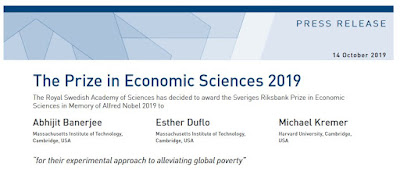
the husband and wife team of Abhijit Bannerjee and Esther Duflo (along with
Michael Kremer) have just been awarded the Economics Nobel Prize. Not just
because it’s only the second time that a woman has won, or because Esther Duflo
is young compared with the 60+ norm for Nobel Prize winners. But because the
work of all three focuses on poverty, and uses an experimental rather than a
theoretical approach – what works, rather than what presents as a neat and
elegant solution.
 And following Daniel Kahneman in 2002 and Richard Thaler in
2017, this is the third time that a behavioural approach has featured in the
economics Nobel prize.


The work of Bannerjee and
Duflo featured in their book ‘Poor Economics,’ where they set out their focus: the
lives and choices of poor people. As the authors state, the debates on poverty
are usually framed by looking at the big questions – what is the ultimate cause
of poverty? How much faith should we place in free markets? Is democracy good
for the poor? Does foreign aid have a role to play? Whereas as Bannerjee and Duflo note in the
book, "the studies we use have in common a high level of scientific
rigour, openness to accepting the verdict of the data, and a focus on specific,
concrete questions of relevance to the lives of the poor."

They invite us to turn away from the feeling that the fight against poverty is too overwhelming and to start thinking of the challenge as a set of concrete problems that, once properly identified and understood, can be solved, one at a time. There’s a lot of behavioural economics in their approach, not because the psychology of poor people is different, but because it’s the same: poor people can be trapped by the same kinds of problems that afflict the rest of us, like lack of information, weak beliefs, and procrastination.
What
We Take For Granted
Our
real advantage comes from the many things that we take as given: we live in
houses where clean water gets piped to us - we do not need to remember to add
chlorine to the water supply every morning. The sewage goes away on its own -
we do not actually know how. We can mostly trust our doctors to do the best
they can - and can trust the public health system to figure out what we should
and should not do. We get our children immunized (mostly!). Our health insurers
reward us for joining the gym - because they are concerned that we will not do
it otherwise. And perhaps most important, most of us do not have to worry where
and our next meal will come from. In other words, we rarely need to draw upon
our limited endowment of self-control and decisiveness, while the poor are
constantly being required to do so.
Make It Easy
The authors invoke the
spirit of Nudge to ensure that policies and practices are designed to make it
as easy as possible for poor people to make the choices that are best for them.
But a lot of the cheap gains are in prevention, and prevention has
traditionally been the area where the government is the main player. The
trouble is that governments have a way of making easy things much less easy
than they should be – eg, government health centres are often closed when they
are supposed to be open.
If
people in the west, with all the insights of the best scientists in the world
at their disposal, find it hard to make basic choices on hard evidence, how
hard it must be for the poor, who have much less access to information? And even the most well intended and well
thought out policies may not have an impact if they are not implemented
properly. Unfortunately, the gap between intention and implementation can be
quite wide
B&D
remind us that we need to resist the kind of lazy, formulaic thinking that
reduces every problem to the same set of general principles. We should listen
to poor people themselves and understand the logic of their choices. We must accept
the possibility of error and subject every idea, including the most apparently
common-sensical ones, to rigorous empirical testing. Doing all of this means we
will be able not only to construct a toolbox of effective policies but also to
better understand why the poor live the way they do.
In
summary: attend to the details, understand how people decide, and be willing to
experiment. All economists should take note!


